Love à la Mode
What can we learn from satire when the context is lost?

This was an etching I probably shouldn’t have investigated while sitting in my aunt’s plush armchair. My extended family walked in and out of the lounge room, glancing at the cricket game on the television before rummaging around the freezer for remnants of sticky date pudding. I sat with my laptop at a precarious angle while I craned my neck to peek under the lid to properly view the image. My hopes to tune out and do some mindless clicking were somewhat thwarted.
I flicked between the tab with the picture and some cursory Google searches to uncover the women's names. Clinking on hyperlinks, I prayed I wouldn’t stumble across a virus in the name of queer curiosity.
I flinched as a cousin walked past. The last thing I needed was for someone to ask what I was looking at—the joys of being out of the closet but not out to everyone. I’m pretty sure it’s an open secret but I’m not the cool, mysterious cousin who can pull off the devil-may-care attitude that keeps everyone guessing.
I’m the autistic academic cousin who spouts off facts about the 19th century. The one they send their kids off to for advice on their school careers.1
This image would have dispelled any doubts about where I sit on the spectrum of straight as an arrow to queer as fuck.
Purely because there is no heterosexual explanation for “Love-a-la-Mode, or Two Dear Friends”:
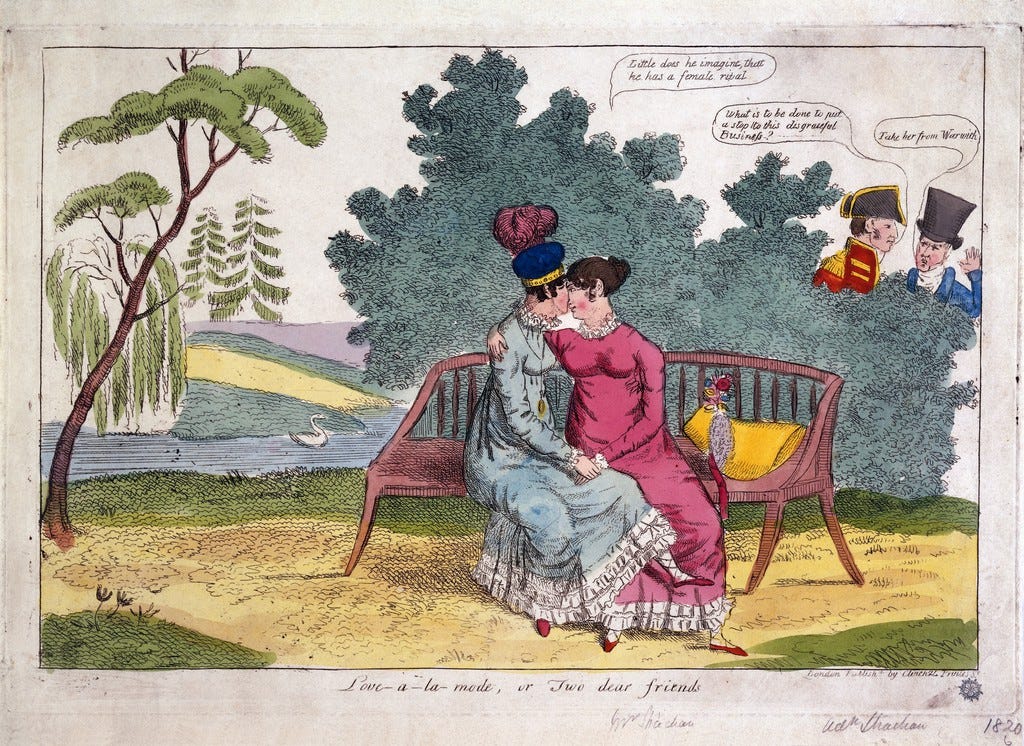
I could see this image in the house of a rich man dabbling in low-risk erotic art. What I couldn’t believe was that it sat in the window of a Picadilly bookstore in 1820.
Let’s have a closer look.
On the left-hand side, there is a generic park scene with a cute little swan floating along a river. Right in the foreground are two women on a park bench, sitting atop each other and sharing a passionate kiss. Meanwhile, on the right-hand side, two men engage in a heated discussion, hiding behind a comically large bush.
(I don’t want to make the obvious joke.)
Based on portraits from the time, Lady Louisa Strachan, Baronness of Strachan, is the woman in blue with her leg in her “friend’s” lap. The other woman, Lady Sarah Greville, Countess of Warwick, has one hand on Lady Strachan’s thigh and the other around her shoulders, pulling her closer. Lady Warwick also has her hat off…very inappropriate for being in public.2
A speech bubble that looks like it’s coming from the bush but is more likely meant to indicate Lady Warwick reads: “Little does he imagine, that he has a female rival”.
The “he” referred to one of the men behind the bush: Sir Richard Strachan, 6th Baron of Strachan. He’s the one decked out in the red jacket and gold epaulettes of a navy Admiral. Fun fact: He was known as Mad Dick by his by those he commanded for his swearing and general anger management issues.
He inflicted so much damage on the French during the Battle of Trafalgar that Napoleon knew his name. I will admit that is impressive.
What isn’t as impressive is that he is the second admiral I’ve written about who married a woman two decades younger than him who later became embroiled in a sapphic scandal. You can read the first story here.

The Admiral asks his companion, “What is to be done to put a stop to this disgraceful business?”
The man next to him replies, “Take her from Warwick.”
Henry Greville, with the oversized top hat, was the 3rd Earl of Warwick. At the time he was also the Recorder of Warwick, a part-time judge in a circuit court. He had previously been Warwick’s representation in parliament but had given up the position once he became the Earl.3
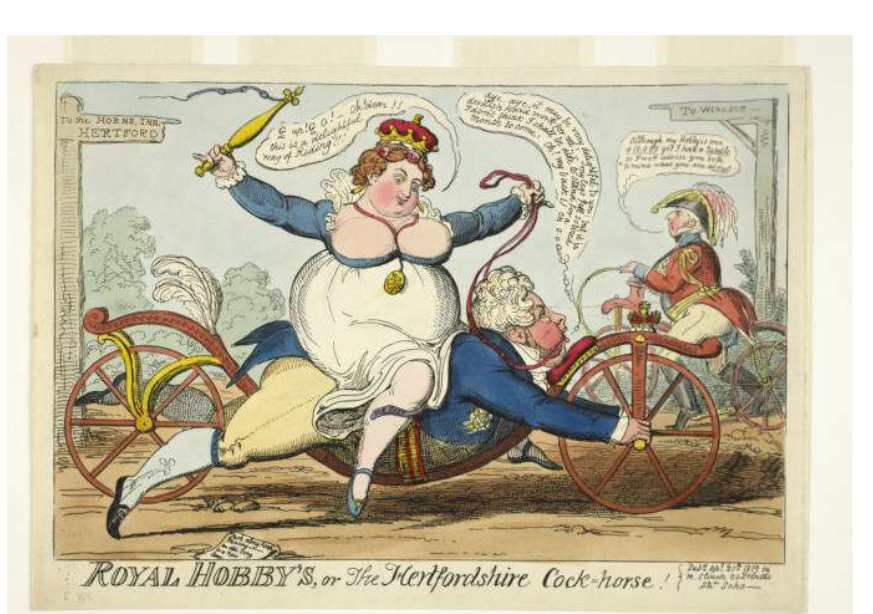
“Love-a-la-mode” was published by M. Clinch but with no attributed illustrator, probably because they were publishing caricatures of the rich and powerful. Based on their other entries in the British Museums Satire Collection, they enjoyed poking fun at the Prince Regent and his extramarital affairs. In case you’re interested here’s an image they published of the Prince Regent being legitimately ridden by his mistress like a bicycle (it’s by George Cruikshank who could be the illustrator of the Strachan and Warwick image).
Navigating around the British Museum Satire Collection unearthed another image of these women embracing in 1820. “Amorous Lady or Tete-a-Tete Extraordinary” was published by E. Brooks and possibly created by William Heath.
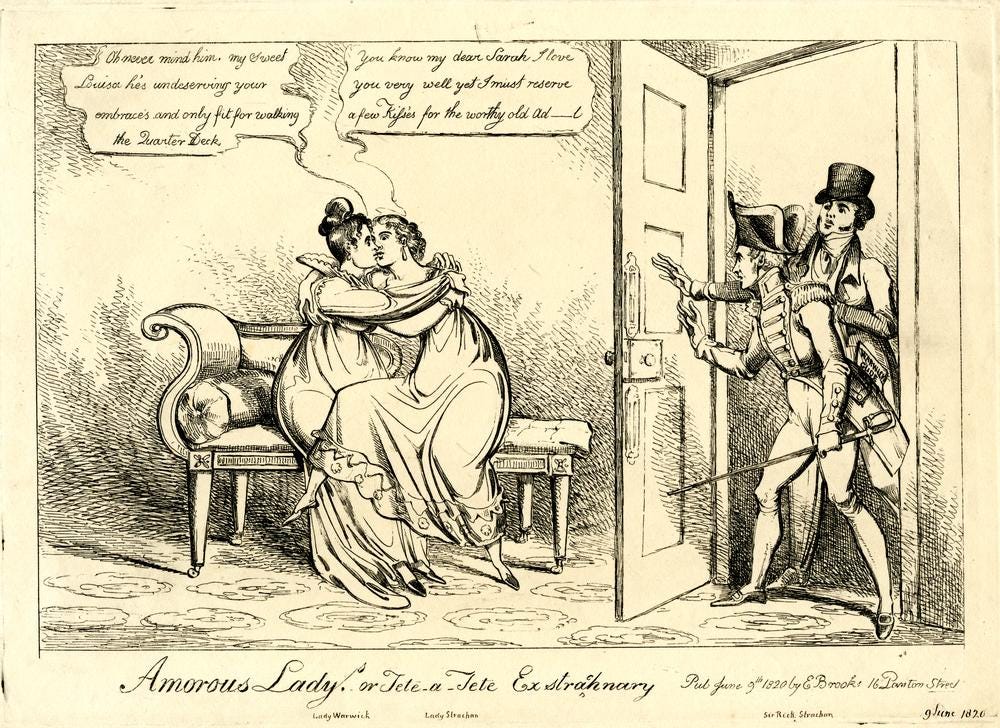
This black-and-white image shows the two women having a cheeky pash on a divan in a domestic setting. Once again, Lady Strachan has her leg over Lady Warwick’s as they wrap their arms around each other’s shoulders.
The caricatures seem to be by different artists with this one being uncoloured and having more delicate linework. The similarity of the women’s positioning may be due to the way prints and etchings were created during the Regency era. According to Stephen E Jones satirical images were often made up of a “ process of accretion, appropriation, and combination of image and text and of previously existing images and texts, often with samples of other earlier prints, remixed and recombined into new objects by way of drawing, etching or engraving” (76).
While it is unclear which image came first, the images are palimpsests, likely created using whichever came first as a template, which was probably a template cribbed from another image.
Although there is a major difference, this time it’s the women talking. Lady Strachan says, “You know my dear Sarah, I love you very well yet I must reserve a few kisses for the worthy old Admiral.”
Warwick replies, “Oh never mind him. My sweet Louisa he’s undeserving your embraces and only fit for walking the Quarter Deck [sic]”.
For context, the quarterdeck is a raised deck of a ship behind the mast where the captain stands giving orders. The number of military men I seem to write about does not correspond to my knowledge of boats…or the Navy.
On the right, the Admiral and Greville burst into the room. Admiral Strachan holds his sword at quarterdeck – I’m convinced quarterdeck is a euphemism for something. This is rather a phallic image especially when looking at the length and placement of the sword.
Behind him is Henry Greville sporting some impressive sideburns.
The illustrator, William Heath, provides the same clues about his political values as M. Clinch does. They don’t like the king. William Heath also seems to hate the military. He’s also a horrible racist in many of his caricatures.
I can only surmise that satirising the friendship between the wives of an Admiral and a Tory politician would be a way of emasculating the men. By extension, it would be attacking the king with whom they are associated, as the figurehead of the law and the military. The men are so ineffectual that their wives find comfort with each other, rather than the men they should love and obey. We’ll discuss this more in a minute because the women again find themselves immortalised in art.
After some extensive Googling and JSTOR searching I stumbled across a poetic representation of the women, attributed to Lord fucking Byron. Of course, the perverted poet has to be involved in everything salacious or gay in the Regency era.
Alright…he’s not so much involved as associated with this story. In the 1820s or 1830s, we’re not entirely sure, the poem Don Leon was attributed to the bastard Byron. It is a passionate defence of homosexuality attributed to the maniacal man and ironically written to his wife.
While the poem has biographical knowledge of the wretched writer, it was written after he died as it references events after 1824. Anyway, it was always more of a Percy Bysshe Shelley thing to make radical statements to piss off those in power (but he was also dead at the time of its composition).
This poem hasn’t quite made it into school syllabi like Don Juan or Childe Harold’s Pilgrimage. Amazingly, it survived after most copies were destroyed under Obscenity Laws at the time.
The poem contains this couplet:
“A pair of breeches S******n and W*****k shock,
They ask no joys beyond each other’s smock” (Line 826-827)
At first, I didn’t know what I was looking at. It may have been the hard cider I drank that hit me more than it should have. I struggled to understand why the academic note mentioned Strachan and Warwick until I realised the amount of asterixis in an older publication of the poem had the same amount of letters as Strachan and Warwick.
I never claimed to be a genius.
This couplet is bawdy and very, very gay for its time. A basic translation is that Strachan and Warwick aren’t interested in men ie. “the breeches”.4 Rather they find joy and sexual fulfillment with each other, underneath each other’s underclothes or “smocks”.
Fuck I love research when I find things like this.
Strachan and Warwick still held enough cultural capital to evoke images of queerness during their lifetimes to be included in the poem which is full of queer sexual innuendos. Either they caused such a scandal with their “friendship” that queerness became associated with them, or it was common knowledge and people would get the reference.
The 1866 reprinting of Don Leon available online through JSTOR and Haithi Trust includes a contextual note:
“These two names (Lady Strachan and Lady Warwick) seem to have been selected by the author, because they had obtained some notoriety for a species of lasciviousness, probably common enough nowadays, but of frequent practice among the Roman ladies. There was a caricature of these two ladies in the window of Fores’ shop in Piccadilly some years ago. Females addicted to these modes of mutual gratification were called tribades and frictrices” (97).
How very 1860s of him.
I do like how the note says it’s more common to find queer women nowadays. Then the writer undercuts that sentiment by saying sapphism is still gross and an abnormal addiction.
The word tribade meant to rub against. It was used to describe queer women by associating them with the act we’d now call scissoring. The tribade as a figure was rather popular in pornography at the time because history loves to prove that we have always been the same.
Fricatrice meant pretty much the same thing but appears to have a connotation with sex work. It was also used to describe an elongated clitoris. Historically, an elongated clitoris has been used to subjugate South-East Asian women and discriminate against intersex people. It fed into the stereotype of the mannish lesbian or the “invert” as the stereotype came to be pathologised, by marking the person as different from “normal” (read: English and white) women. It has been a characteristic used to other marginalised communities and masculinise them, as Leila J Rupp writes in Sapphistries (6).
While this academic note was helpful, it didn’t give me any more leads. It was time to do a newspaper search.
At this point we’ve transitioned from fuck I love research to fucking research and fuck slow Australian internet connections. I tried unearthing any reference to these women in newspapers from 1819 and 1820.
I plugged in as many names as I could. Louisa Dillon, Lady Strachan, Louisa Strachan, Baroness Strachan…nothing. Sarah Greville, Countess Warwick (this one did reveal she had attended the Duke of Devonshire’s ball in 1821 and donated to an art school) and even Lady Monson, her title from her first marriage.
It turns out there’s another bloody Lady Monson associated with queerness but in the Victorian era, she was friends with Robert Browning (see, I told you he’d be back) and none other than Emily Faithfull (this connection to the Langham Place Group I was not expecting). If you’d like to read more about the divorce scandal Emily Faithfull was involved in, you can here.
I consoled myself by looking into the year of controversy, 1820.
This was a big year for England.
The Tories remained in power led by Prime Minister Robert Jenkinson, Earl of Liverpool. More radicals were jailed. Percy Shelley published Prometheus Unbound, Anne Bronte was born, and King George III died.
This meant the ascension of another George, George IV, who had been the Prince Regent for nine years. George IV was hated by his people, who nicknamed him Prinny. Before he officially became king, Prinny was in the middle of an attempt to divorce his wife, Caroline of Brunswick. Unfortunately for him, the English loved Caroline, who was in exile living her best life and most likely sleeping with the head of her staff, a married Italian man.
Caroline rushed back to England and was heralded as England’s saviour from Prinny. The divorce never went through despite all the muckraking, because it would have destabilised the monarchy and parliament. No one wanted to see a repeat of France. Except maybe the disenfranchised.
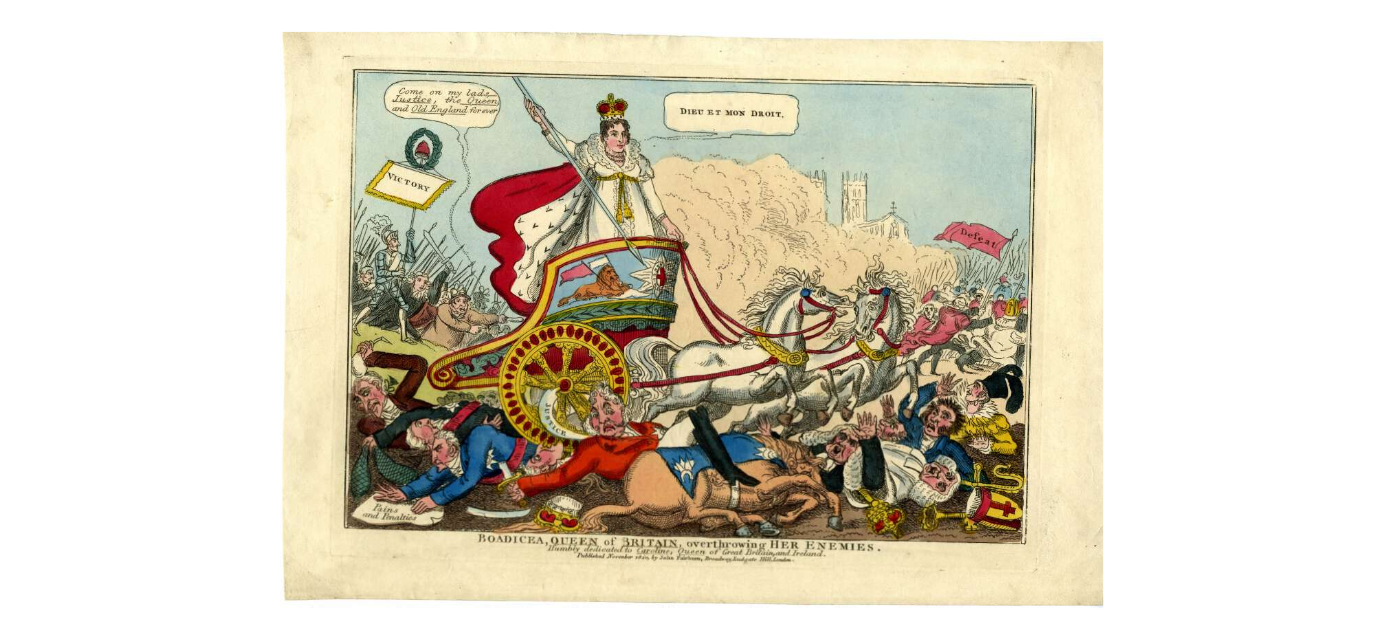
One day I’ll write a post about the caricatures of George and Caroline which was a fascinating tangent that put this article back at least a day. But here’s an image of Caroline as Boudicca.
It was clear Prinny would never be able to control his wife the way he wanted to. Let’s think about who else couldn’t control their wives.
Strachan and Warwick, of course.
Like most historical scholarship this theory is based mainly off is well-informed guesswork. Whatever the caricature directly references has fallen out of our shared cultural knowledge (along with the Odessey) so I will have to look elsewhere to create meaning.
What do we do with satire when we don’t know the specifics?
Have you ever sat with your parents and watched an old Law & Order episode (Law & Order: SVU in my household) and there’s a reference to something or someone who was well known to Boomers or Gen X and your parents laugh? Meanwhile, you just sit there knowing that there’s a joke due to the cadence but not understanding it.
That’s exactly how I feel about this image.
So, I’m going to have to rely upon my basic knowledge of art analysis and my more in-depth knowledge of the Regency era and 19th-century queerness.
That means I’m going to read this image as seriously as I can. I’m going to follow in the footsteps of the New Critics with their close readings of texts, which we’ve already started, and then add the context. This way of reading satire “does not deny the presence of particulars but reinterprets them as symbols, representatives or fictive re-creations” (Griffin 117). To read this way Strachan and Warwick become fictionalised versions of themselves. We are not so worried about the particulars but what they may represent more generally for their context.
On a basic level, we have two women sharing a cheeky pash on a park bench and a divan who are intruded on by their husbands.
The first image is called “Love-a-la-Mode”, a-la-mode meaning fashionable or of the current style. Rather than being a satire of the behaviour of just these two women, we can read this as a satire of women’s friendship in general. Particularly romantic friendship, which I harp on about a lot on this blog.
Romantic friendship was a deep emotional bond between generally young women. In theory, the depth of this emotion would prepare women for what they would eventually feel about their husbands. These friendships were tentatively accepted due to their perceived asexuality, however, they were often physical and could be incredibly erotic. These relationships were thought to fill an emotional need but they could also fill a sexual need.
This image contradicts this belief of transferrable feelings.
The caricatures of Strachan and Warwick show a failure of romantic friendships. Instead of loving their husbands because they continue to fixate on other women.
The feelings have not been transferred to a man. Instead, women are kissing women on benches; they’re acting like they’re in love. These men’s “rivals” as it’s put in the first image, are women. That doesn’t fit inside a heterosexual framework. At the time this would have been seen as deviant or unusual, and somewhat emasculating. The men are not “man enough” for their wives, so sexual fulfilment is sought elsewhere.
The word “rival” connotes competition usually relegated to the heterosexual realm. While this is satirising the two women, the women’s relationship is still seen to have an erotic and sexual component. The idea of being a “female rival” for affection is rather overtly showing that women were capable of having romantic and sexual feelings for each other. They must be able to otherwise their relationship wouldn’t be a threat to their marriages.
In the first image, the men resort to being voyeurs of their wives’ relationship, unable to intervene. The idea that Warwick could be a rival is not referring to a competition between heterosexuality and homosexuality, in the way we’d know it now. Rather it’s masculinizing one woman while emasculating a man.
The men cannot satisfy their wives the same way a friend of the same gender can. The Admiral is forced to ask what to do about his wife’s behaviour that he cannot control like a good husband should. The only solution Warwick can offer is a separation of the women.
Remember who else couldn’t control his wife so much so that he had to separate her from England (the third party in their marriage)? The incoming King.
In the second image, Amorous Ladies, Warwick challenges the virility of the Admiral when Lady Strachan says she must “reserve a few kisses for the worthy old Admiral.” The idea of reserving a few kisses gives the sense that she has some kind of quota. It also gives a feeling that she is reserving these kisses out of duty to her “old” husband who would be considered successful and “worthy” of her love and devotion for his role as a war hero, not genuine affection.
At this time he is no longer in active service. He’s a figure of a bygone era of Napoleon, Trafalga and heroism. Now he’s at home, highly decorated but hitting his sixties and married to a woman decades younger than him.
Countess Warwick disparages him as “undeserving of [Louisa’s] embraces” and “only fit for walking the Quarter Deck”. It gives the impression of a man who stands and shouts rather than taking part in the action. He is not the husband he should be. While her husband may be “worthy” for his military service which should be a sign of masculinity and virility, his sword placement is rather flaccid.
Nor does the Admiral’s worthiness stop her from sticking her tongue down her friend’s throat.
They seem rather keen to keep going on with the embrace.
While the Admiral may have burst into the room, sword drawn ready to fight an intruder, he cannot duel Lady Warwick over his wife’s infidelity, nor can he take her to court for reparations after damaging his property in criminal conversation with his wife.5
The women’s behaviour is not legally a crime either. There is no external recourse for the men (who are lawmakers and law enforcers) to pursue, they should be in control of their wives and not have to rely on courts. Based on these images this is rather difficult. Strachan can only restrict the women’s access to each other, ie. “take her from Warwick”.
The damned women don’t want to be governed.
Anna Clark’s article “Queen Caroline and the Sexual Politics of Popular Culture in London, 1820” highlights the way men’s patriarchal power was undermined by satire. She writes “Carolinite satirical propaganda undermined the metaphorical power of male potency” as “caricaturists slyly ridiculed the phallic principles of kingship and war” (Clark 57).
There is a sense of impotence in these images, an emasculation of these men in the way they talk about the women in their lives and the way the women talk about them. They may control the world of politics and war, but they cannot control their women, one of the greatest insults for a man of this era.
They’re not alone in this struggle to control their womenfolk. Aren’t they Prinny?
While Caroline of Brunswick may commit some more classically heterosexual deviance, Strachan and Warwick have their marriages upended by their wives’ relationships with another woman.
Overall, there are a few ways you can read these images:
It could be a case of people attempting to emasculate two men close to the centre of power
It could be reflective of an open secret, as it appears in the Don Leon.
It could be a gross exaggeration of the women’s friendship to humiliate them
It could be a greater comment on romantic friendships, or
The men who should represent everything the King is capable of are incapable of controlling their women, just like the King himself. They fail at their duties as husbands. How can they be the protectors of England?
I’m inclined to think it’s a mixture of all of them.
Aftermath
After these caricatures, I cannot find much about Sarah Greville aside from the death of her son from her first marriage, her patronage of Joseph Severn the painter, and her death in 1851.
I did find Lady Strachan again in 1826, this time coupled in some heterosexual adultery with Lord Hertford, the son of King George IV’s mistress. This open secret was immortalised by William Heath (the illustrator of “Amorous Ladies”) in “Paul Pry’s Extrachanary Peep into Piccadillo”.
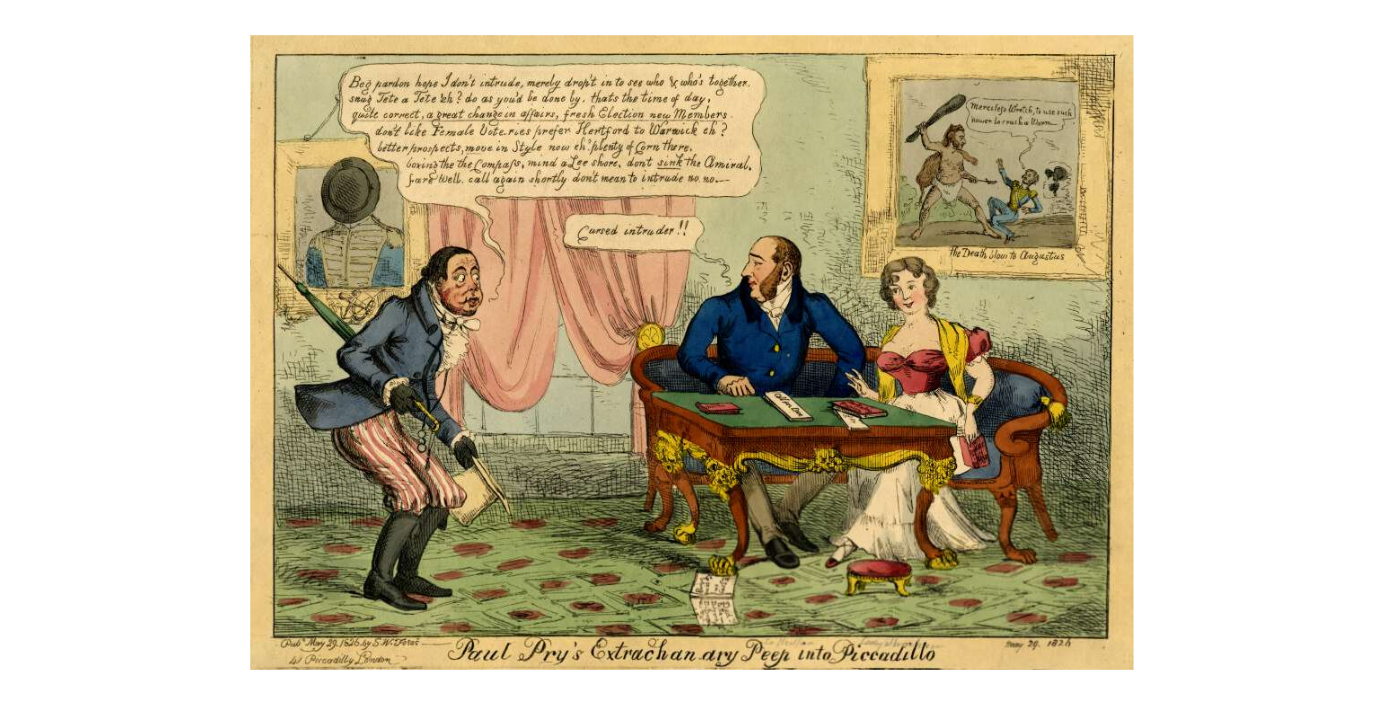
Hertford was a successful gambler and the pamphlet says: “All for love and The Ruling Passion”, hinting that Lady Strachan is pulling the strings of Hertford’s political ambitions through the influence of her feminine wiles.
Paul Pry who appears to be a stock character of Heath’s, bursts into a room where Lord Hertford has his hand on Lady Strachan’s thigh. She was still married to the Admiral. Pry says a lot but the sentence I’m interested in is:
“fresh Election new Members—don't like Female Vote-ries prefer Hertford to Warwick eh? better prospects, move in Style now eh? plenty of Corn there, boxing the Compass, mind a Lee shore, don’t sink the Admiral, fare Well, call again shortly don't mean to intrude no”.
Again so much context has been lost and I struggle to parse meaning out of it. However, the Warwick is not Henry Greville but his brother Charles who was up for election against Lord Hertford. Charles Greville won the election and became the Member for Warwick. I can’t conclusively prove whether Strachan is supposed to be on the side of Hertford or Warwick. I’m assuming it was the side of her current paramour, not the brother-in-law of the woman she may or may not been having an affair with.
Strachan crops up again after Hertford dies. With the money he left her, she purchased the title of Marchesa di Salza and a property in Naples, Villa Rocca Matilda. She died in the villa in 1869, 40 years after her husband. I’m hoping she got up to a fair bit of mischief in the second half of her life.
I wish I knew more about these women and the scandal they caused. Whether it was a sapphic scandal or a heterosexual scandal. I wish I knew exactly what these caricatures said about them, about their husbands and the time they lived. I wish I knew what happened to their friendship.
All I can do is make an educated guess, but I will be keeping an eye out for them in my archival travels.
But hey, isn’t it nice to have two images of women happily kissing each other?
My advice is always to do what you’re interested in. It turns out my advice is wrong because their parents didn’t warn me that they actually wanted me to talk their kid out of taking psychology over commerce.
Now there is another version of this image that has scrawled underneath the women who they are, which is different from the way I interpret this image. I could very well be wrong, but I am basing my recognition of the women on portraits of them from the time and another caricature that labels them quite clearly.
A couple of years later he would become the Lord-Lieutenant of Warwick which was a position given to wealthy men allowing them to control the local militia (don’t tell Elon). He also became a Lord of the Bedchamber for the last two years of George IV’s reign. He and Prinny were pretty chummy.
Referring to men as a whole as “breeches” is a fun literary technique known as synecdoche where you use a symbol to express a whole. Fun dinner party facts that I paid too much money to learn.
Seriously, men used to be able to take each other to court to receive compensation for the sullied goods their wives became after they slept with someone else.